How it works
A wire loop runs around the area your dog can use and connects back to a transmitter, usually mounted in the garage. The transmitter sends a radio signal along the wire. When your dog's receiver collar gets within a set distance of the wire, it gives a warning tone, then a mild correction if the dog keeps going. You can adjust how wide that warning zone is.
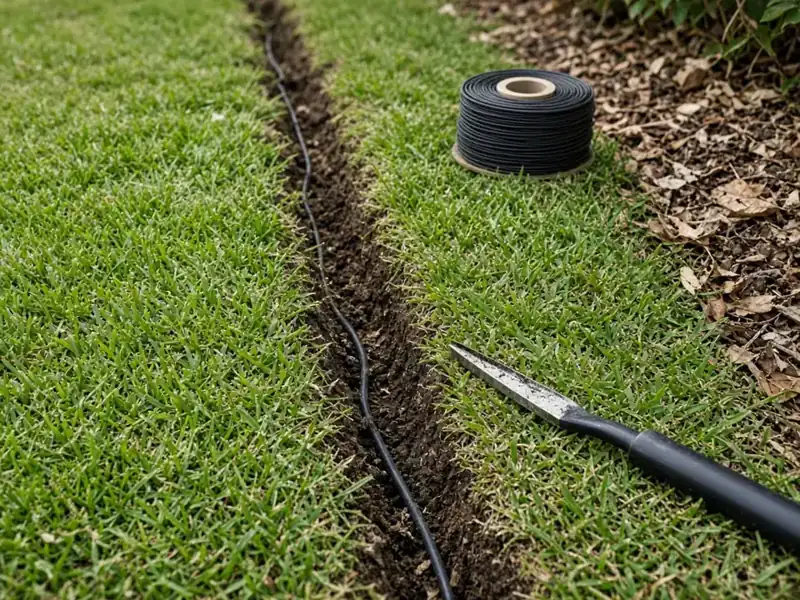
What goes into a good installation
Layout
Common layouts include a full perimeter, front-yard-only or back-yard-only loops, and "double loops" that leave a stretch of wire uncorrected so the dog can only use part of the property. Twisted wire is used where the wire has to pass through an area without creating a boundary, such as the path back to the garage.
Wire gauge
Store kits often use thin 20-gauge wire. Professionals usually use 18, 16 or 14 gauge, which is thicker and holds up better to frost heave, roots and the occasional edger. Heavier wire costs more but means fewer breaks over the years.
Wooded lots
Wooded lots are common in Rockford, Ada and parts of Walker. Roots make trenching slower, and wire may be laid along the surface and pinned in leaf litter or run around large trees rather than through root zones. This is one of the biggest cost drivers.
Driveways, sidewalks and gardens
For asphalt or concrete, installers saw a thin groove, lay the wire and seal it, or use an existing expansion joint. Gravel can be trenched. Gardens and beds are usually routed around, or the wire runs at the edge of mulch.
Clay soil and frozen ground
West Michigan clay can be hard to trench in late summer and sticky in spring. Once the ground freezes, usually from December into March, most installers stop trenching new wire. Some will lay a temporary surface wire in winter and bury it after the thaw. Frost heave can occasionally stress the wire, which is another reason to use heavier gauge.
Before digging: MISS DIG 811
Michigan law requires notifying MISS DIG 811 at least three business days before digging, even for a shallow slit trench. Gas, electric and telecom lines are marked for free. Private lines such as sprinkler lines, landscape lighting or a line to a detached garage aren't marked by MISS DIG, so point those out to the installer.
Upkeep
- Replace or recharge collar batteries on schedule, and more often in cold weather.
- Test the collar at the boundary every month or so with the tester tool that comes with most systems.
- Check collar fit: the contact points need to touch skin, and long-coated breeds may need longer contact points.
- Mark the wire on a sketch of your yard so future landscaping doesn't cut it.
See the cost guide for typical prices.
Questions about wired systems
How deep is the wire buried?
Usually about 1 to 3 inches, which is deep enough to avoid mowers and aerators but shallow enough to find and fix. Some installers go a bit deeper in high-traffic areas.
What happens if the wire breaks?
Most transmitters beep or flash when the loop is broken. Common causes are edging, aerating, digging for landscaping and animals chewing exposed wire. Breaks can be located with a wire-break locator and spliced with waterproof connectors.
Can I install it myself?
Many homeowners do with a store kit. The hard parts are getting a clean layout, crossing driveways, burying wire neatly in clay or rooty soil, and training consistently. Professionals usually use heavier wire and a power trencher, and most include training.